

https://www.bloomsbury.com/us/silk-roads-9781547600212/?srsltid=AYCX9vKKf3n75546DAFgYHMpTE88vcqQoUhstlirNCI7tPRJ7coIKdy0
I was rather pleased with myself when I started reading The Silk Roads by Peter Frankopan. I was absolutely powering through it, making excellent progress with what I thought was a substantial history book.
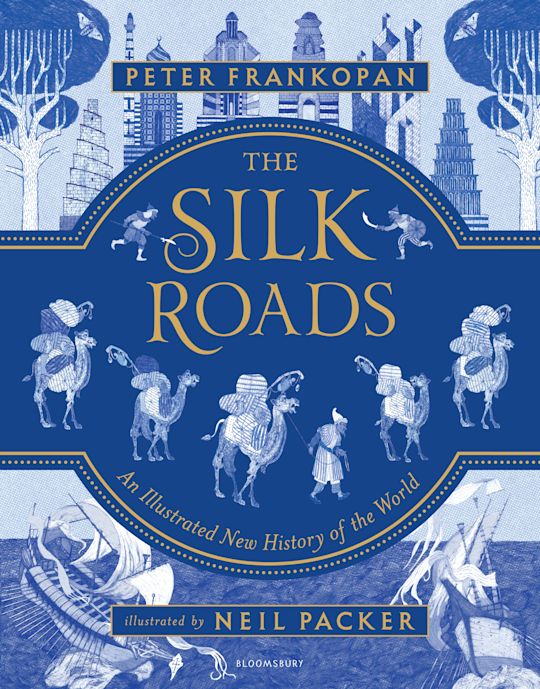
Then I realised I’d picked up the 2018 illustrated edition for younger readers rather than the original 2015 book. That certainly explained a few things!
As it turned out, this was a rather happy accident. I was reading it as we travelled through Kyrgyzstan towards the World Nomad Games, and it offered exactly the kind of broad historical overview I needed as we began exploring Central Asia.
I’d already spent time travelling through India and China, and we were now making our way through a region that had connected these great civilisations for centuries. The book helped bring those connections together.
A different perspective on world history
One of the things I particularly enjoyed about Frankopan’s approach was the way he shifted the focus of world history away from its traditional European centre.
Instead, he placed the vast networks of trade, migration, conquest and cultural exchange that connected China, India, Central Asia, the Middle East and Europe at the heart of the story.
The Silk Roads weren’t a single road, of course, but a collection of interconnected routes through which goods, people, religions, technologies and ideas travelled over centuries.
And Central Asia was far from being some remote region on the fringes of history. It was one of the great crossroads of the world.
This became increasingly apparent as we travelled.
In China, we’d explored places such as Dunhuang and Kashgar, where the history of the Silk Roads is still very much part of the landscape. We’d also travelled through India, whose long history of trade and cultural exchange connects it with the wider networks described in the book.
Now, as we drove through Kyrgyzstan, we were entering another part of that enormous historical story.
I loved being able to see how these places fitted together.
Connecting the historical dots
I’ve always been interested in history, and I wasn’t coming to the subject entirely fresh.
I already had a reasonable understanding of some of the major figures and empires that shaped Central Asia, from Genghis Khan and the Mongols to Timur and his successors, and eventually the expansion of Russian influence across the region.
But knowing about individual rulers and empires isn’t quite the same as understanding how they all fit together.
That’s where this book was particularly useful.
Frankopan presents a sweeping narrative that connects political power with trade, religion, geography and cultural exchange. Rather than treating each empire or civilisation as a separate chapter in history, he shows how developments in one part of the world influenced events elsewhere.
I particularly enjoyed the emphasis on the movement of ideas and knowledge alongside more tangible goods.
Silk, spices, precious metals and other commodities were important, but so too were the religions, technologies and cultural traditions that travelled along these routes.
Buddhism, Islam and Christianity spread through networks of travellers, merchants and missionaries. New technologies and knowledge moved between societies, sometimes transforming life thousands of kilometres from where they originated.
It was a useful reminder that the world has been interconnected for a very long time.
Reading history while travelling through it
I read the book as we drove through Kyrgyzstan towards the World Nomad Games, which felt particularly appropriate.
The Games celebrate the traditions, sports and cultural heritage of nomadic peoples, including communities whose histories are closely connected with the landscapes of Central Asia.
As we travelled through the mountains and valleys of Kyrgyzstan, it was easy to imagine the importance of these routes long before modern roads and national borders existed.
And the connections didn’t end there.
Our travels would also take us through Kazakhstan, Uzbekistan and Tajikistan, each with its own extraordinary history and relationship with the wider Silk Roads.
Kazakhstan’s vast steppes were once crossed by nomadic peoples, traders and armies. Uzbekistan is home to some of the great cities of the Silk Roads, including Samarkand and Bukhara, which became important centres of commerce, scholarship and culture. Tajikistan’s history reflects the enduring influence of Persian civilisation and the movement of people through the mountains and valleys of Central Asia.
What I found fascinating was how these places, which today exist as separate countries with distinct national identities, were once connected through shifting networks of trade, culture and political power.
Reading about these connections while travelling through the region gave me a much stronger appreciation of the historical landscape around us.
A wonderfully accessible introduction
Of course, the 2018 edition is written for younger readers, which explains why I was making such impressive progress!
It moves quickly through an enormous amount of history, introducing major events, civilisations and historical figures without getting bogged down in excessive detail.
For someone wanting a comprehensive examination of the Silk Roads, this probably isn’t the edition to choose. There simply isn’t room to explore every historical complexity or debate in depth.
But I don’t think that diminishes its value.
In fact, the clarity and pace were two of the things I enjoyed most. It was easy to follow, engaging and genuinely interesting, even when covering periods of history I was already reasonably familiar with.
Sometimes a broad overview is exactly what you need, particularly when you’re travelling and want to understand the historical context of the places you’re exploring without committing to an enormous scholarly volume.
And while the book is aimed at younger readers, I think there’s plenty here for adults who want an accessible introduction to a fascinating subject.
My verdict
The Silk Roads turned out to be a delightful surprise.
What began as a slightly amusing misunderstanding about which edition I’d downloaded became a genuinely useful introduction to the wider history of Asia and the connections between its civilisations.
I enjoyed the accessible writing, the sweeping historical perspective and, most of all, the way it helped connect different periods, places and empires into a more coherent picture.
I’d particularly recommend this edition to younger readers, anyone relatively new to the history of the Silk Roads, or travellers looking for an enjoyable introduction to the region.
For me, it was the perfect companion as we made our way through Kyrgyzstan towards the World Nomad Games, building on our travels through India and China and helping me better understand the places we would explore across Central Asia.
And while I might not have been quite as impressively fast a reader as I’d initially thought, I certainly finished the book with a better understanding of the remarkable history of this part of the world.
Rating: ★★★★
Leave a Reply