
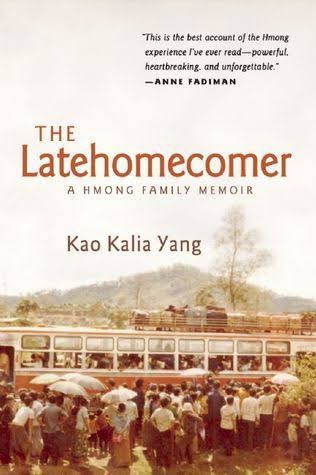
Before reading The Latehomecomer, I knew a little about the Hmong people from a perhaps unexpected source: a sewing YouTuber I follow. I knew there was a significant Hmong community in the United States, and I had some awareness of their distinctive textile traditions and culture.
What I didn’t really understand was why so many Hmong people had ended up in America.
Kao Kalia Yang’s memoir filled in that enormous gap in my knowledge.
The Latehomecomer: A Hmong Family Memoir tells the story of Yang’s family and their journey from the mountains of Laos, across the Mekong River into refugee camps in Thailand, and eventually to a new life in the United States. Yang herself was born in a refugee camp in Thailand, but the story begins before her birth, with the experiences of her parents and family during and after the Secret War in Laos.
I read the book as Darryl and I were driving across Laos on our way towards China. That made the geography of Yang’s story extraordinarily immediate.
The mountains her family moved through weren’t distant landscapes I had to construct in my imagination. They were the mountains outside our windscreen, the same terrain we were navigating It Zwibble through. Of course, our experience of those landscapes could not have been more different, but being physically surrounded by them gave me a sense of scale and place that I wouldn’t have had reading the book at home.
While I was reading, we also visited the UXO museum in Luang Prabang. Laos remains profoundly affected by unexploded ordnance left behind by the massive bombing campaign conducted during the Secret War, and seeing evidence of that continuing devastation while simultaneously reading one family’s experience of the conflict was striking.
History on that scale can easily become numbers: bombs dropped, people displaced, refugees resettled, casualties counted.
Memoir brings it back to individual people.
Once again, I found myself encountering human atrocity through the perspective of children. There is something particularly confronting about that. Children don’t choose wars, political ideologies or the circumstances into which they’re born, yet they experience their consequences in ways that can shape the rest of their lives.
The Latehomecomer also reminded me that this doesn’t stop with the children who directly experience war.
Yang’s own story demonstrates how displacement, trauma and loss move between generations. Children born afterwards can inherit the consequences too: through their parents’ memories, through cultural displacement, through stories of a homeland they may barely remember or have never known, and through the challenge of building an identity somewhere new.
But the relationship that affected me most wasn’t primarily about war. It was the relationship between Yang and her grandmother.
Her grandmother is one of the emotional anchors of the memoir, connecting family, culture, memory and the world the family has lost. Yang writes about her with enormous tenderness, and her description of her grandmother’s funeral particularly struck a chord with me.
I had a wonderful grandmother too.
Unfortunately, I never made it to her funeral because our car broke down on the way. It is one of those strange, frustrating memories that stays with you. So while Yang’s relationship with her grandmother comes from a life and culture completely different from mine, the love within it felt immediately recognisable.
That was perhaps what I appreciated most about The Latehomecomer. It taught me about a history and a people I knew far too little about, but it did so through relationships that felt deeply human: parents trying to protect children, children carrying the experiences of their parents, families separated from their homeland, and grandchildren loving their grandparents.
Reading it while travelling through Laos made it impossible to separate the memoir from the landscape around me. The mountains, our visit to the UXO museum, and what I was learning about the legacy of the Secret War all became intertwined with Yang’s family story.
I’d recommend The Latehomecomer to anyone interested in memoir, migration, the Hmong people or the less widely understood consequences of the wars in Southeast Asia. But I think its reach is broader than that. It’s also a book about family, memory, belonging and what happens to identity when people are forced to leave one home and somehow build another.
I started the book knowing that there was a large Hmong community in America.
By the end, I understood something of the human story behind why.
Leave a Reply