
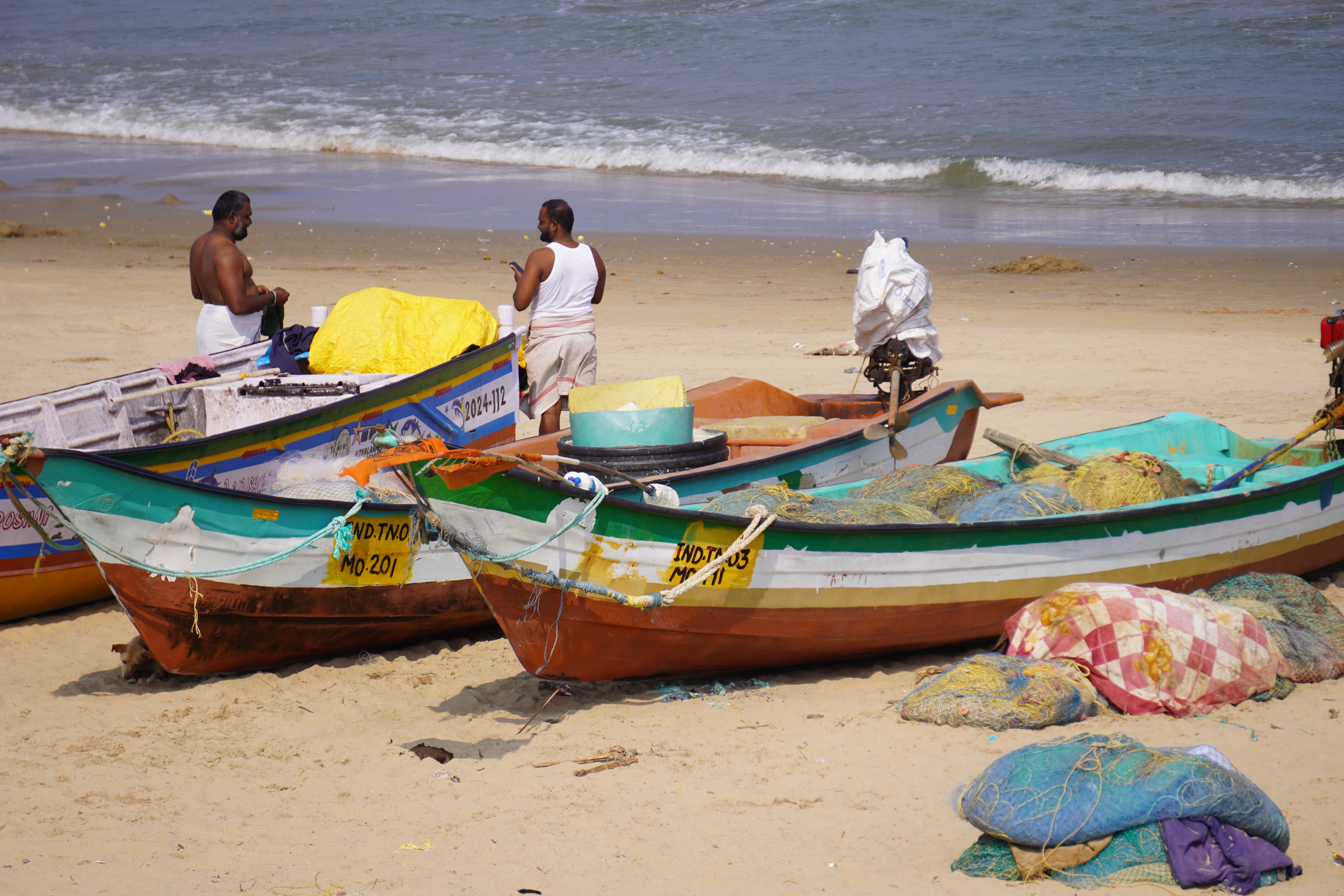
Chennai probably isn’t on many people’s list of must-visit destinations in India.
It doesn’t have the instantly recognisable landmarks of Delhi, the palaces of Jaipur or the backwaters of Kerala. For many travellers, it’s simply somewhere they fly into before heading somewhere else.
To be honest, that was almost us too.
We only ended up spending so much time in Chennai because it was meant to be the start of a much bigger adventure. The plan was to ship our New Zealand-registered campervan from New Zealand to India, begin our overland journey here, travel around the country, then return to Chennai to export it again.
As many of you already know, that plan didn’t quite work out.
Instead, we found ourselves with much more time in the city than we’d ever intended. Looking back, we’re actually quite grateful for that because it gave us the chance to experience a side of Chennai that many visitors probably miss.
This isn’t a city overflowing with bucket-list attractions. It’s a city where people live and work. It’s a major business hub with a huge IT industry, and that seems to be what brings most people here. During our stay we saw very few foreign tourists, but we met plenty of friendly locals who were curious about why we’d chosen to visit.
If you’re planning to spend a few days in Chennai, these are the four experiences we’d recommend.
Explore Mylapore on a walking tour
One of the first things we look for whenever we arrive somewhere new is a walking tour.
They’re one of the easiest ways to get your bearings, understand a little of the local history and ask all the questions that inevitably pop into your head during those first couple of days.
We joined a free walking tour around Mylapore, one of Chennai’s oldest neighbourhoods. “Free” is always a little misleading. These tours operate on tips, so while there’s no fixed cost, you’re expected to pay what you think the experience was worth.
One thing that surprised us was that we ended up being the only people on the tour.
Normally we’re walking around with travellers from all over the world, but this time it was just us and our guide, which made it feel much more like a conversation than a formal tour.
The morning focused heavily on temples and religion.
That’s probably worth knowing before you book because if, like us, you’re not particularly religious, it isn’t immediately obvious from the description.
In fact, one of the very first questions our guide asked us was whether we were spiritual.
“No.”
“No.”
I don’t think she’d expected both of us to answer quite so quickly.
Despite that, we really enjoyed the experience. Rather than feeling like we were learning about religion, it felt like we were learning about Tamil Nadu and the role different faiths have played in shaping the region.
Our guide was in her early twenties, and some of the conversations we had with her ended up being just as interesting as the temples themselves. At one point she was talking about how some traditions belonged more to her grandparents’ generation and how younger people viewed things differently. Five minutes later she was telling us she’d recently had her horoscope read.
It was a lovely reminder that people rarely fit neatly into the boxes we sometimes create.
If nothing else, we’d recommend doing a walking tour early in your visit. You’ll leave understanding Chennai a little better than when you arrived.

Want to do this?
We booked through GuruWalk. The recommended tip for this tour is €15-50 per person. We paid in Indian Rupee. As this tour involves visiting religious sites, you need to have your knees and shoulders covered. Bring water, a scarf to cover yourself and a sunhat, and wear comfy shoes!
Visit the birthplace of British Madras
If there’s one historical attraction that shouldn’t be overlooked, it’s Fort St. George.
Built by the British East India Company in the 1600s, this was the first major English settlement in India and the place from which British influence gradually expanded across much of the subcontinent.
We’d actually read online that the museum was free. It wasn’t. Like many attractions we visited in India, there was a local price and a foreign visitor price. Even so, it was inexpensive enough that it certainly wasn’t going to break the budget.
Inside, the museum does a good job of explaining the city’s colonial past without requiring you to spend hours reading every display.
One exhibit that caught our attention showed how the river surrounding the fort had been gradually altered over the decades as part of the settlement’s defences. It’s one of those little details we’d never have thought about otherwise.
The highlight, though, was seeing the original Indian national flag that was first raised when India gained independence in 1947.
Whether you’re interested in colonial history or modern India, it’s worth seeing simply because of what it represents.
Want to do this?
Official website: Incredible India – Fort St George
Opening hours: 9 am–5 pm, Saturday to Thursday. Closed Fridays.
Entry fees:
| Visitor | Fort | Fort Museum |
|---|---|---|
| Indian adults | ₹5 | ₹15 |
| Foreign adults | ₹100 | ₹200 |
| Children under 15 | Free | Free |
Prices and opening hours are correct at the time of publication. We recommend checking the official website for the most up-to-date visitor information before your visit.
Watch cricket where cricket matters most
One of our favourite ways to get to know a country is through sport.
We’ve been to football matches, baseball games and all sorts of sporting events while travelling because they often give you a glimpse into local culture that museums simply can’t.
As luck would have it, Chennai was hosting matches during the ICC Men’s T20 Cricket World Cup while we were there.
Tickets to watch New Zealand play Canada cost us about NZ$6 each.
For Darryl, that was an opportunity too good to miss. He’s always enjoyed cricket, and seeing international cricket in India is a bit like watching football in Brazil or rugby in New Zealand. It’s where the sport really comes alive.
Megan was a little less convinced. Watching sport generally isn’t how she’d choose to spend an afternoon while travelling. As it turned out, She loved it. Not because she suddenly became a cricket fanatic, but because the atmosphere was incredible.
People danced between overs. Drums echoed around the stadium. Music blasted through the speakers. Every boundary, every wicket and every good piece of fielding seemed to spark another celebration.
Even if you don’t fully understand what’s happening on the pitch, it’s impossible not to get swept along by the excitement.
T20 probably helps too. Matches last around three hours, making them much more approachable than some of the longer formats of the game.
One of our favourite parts, though, had nothing to do with cricket.

Like so many sporting events we’ve attended overseas, we started chatting with the people sitting around us. Before long we’d exchanged Instagram accounts, talked about our travels and received invitations to visit other parts of India if we ever made it there.

That’s the sort of thing we’ll remember long after we’ve forgotten the final score.
Want to do this?
Now, the chances of a World Cup match being on are slim. But we’d still recommend catching some live cricket. You can buy tickets here: Chennai Super Kings ticketing information
Make time for Mahabalipuram
If there’s one thing we’d tell almost everyone visiting Chennai to do, it’s take a day trip to Mahabalipuram.
We’d wanted to visit ever since a friend in New Zealand mentioned it months earlier, so finally making it there on our last day in India felt like ending the trip on a high.
Getting there almost became an experiment.
We’d looked at organised tours and private drivers, but the prices seemed surprisingly high. One quote came in at around 7,000 rupees for the day.
Instead, we decided to try booking an Uber. The trip down cost us around 900 rupees. The return journey was about 1,200. It worked perfectly. If prices are still similar when you’re reading this, we’d happily recommend doing the same.
Mahabalipuram is a UNESCO World Heritage Site, famous for its rock-cut temples, enormous stone carvings and monuments built by the Pallava kings more than 1,200 years ago.

Entry cost us 600 rupees each, and the ticket covered all of the main archaeological sites. Considering how much there is to see, it felt like excellent value.
Megan should probably admit at this point that she’s a complete archaeology nerd. She absolutely loved wandering around the site.
Krishna’s Butter Ball is exactly as strange as it looks in photos, the huge carved relief known as Arjuna’s Penance is astonishing when you stand in front of it, and the Shore Temple, sitting just metres from the Bay of Bengal, is every bit as impressive as we’d hoped.
By lunchtime the heat was definitely catching up with us.
After exploring the temples we found somewhere overlooking the beach for a cold drink before Megan wandered down to paddle in the Bay of Bengal. Darryl watched from the shore!

Unfortunately, we’d forgotten to pack our swimming gear, so a proper swim will have to wait until next time.
This was probably Megan’s favourite day in India. A chance to be at the coast, where the crowds were more manageable, exploring ancient sites, and enjoying the slower pace of life!
Want to do this?
Official links for Mahabalipuram:
- Heritage information: UNESCO – Group of Monuments at Mahabalipuram
- Tickets: Archaeological Survey of India – Official Online Ticket Booking
Note, we didn’t pre-purchase tickets. We just purchased tickets at the entrance.
Opening hours: 6 am–6 pm, daily, for the main monuments.
Entry fees:
| Visitor | At ticket counter | Online |
|---|---|---|
| Indian adults | ₹40 | ₹35 |
| Foreign adults | ₹600 | ₹550 |
| Children under 15 | Free | Free |
Opening hours and admission prices are correct to the best of our knowledge at the time of publication. We recommend checking the official ASI ticketing website for the latest information before visiting.
Is Chennai worth visiting?
We don’t think Chennai is somewhere we’d recommend flying halfway around the world just to see.
But I do think it’s a city that’s worth slowing down in if your travels bring you here.
It’s easy to write it off as a transit point, yet we found plenty to enjoy once we stopped expecting it to compete with India’s headline destinations.
More than anything else, we’ll remember the people.
Everywhere we went, people wanted to stop and say hello, ask where we were from or take a photo with us. We found everyone to be incredibly generous with their time, and despite the organised chaos that seems to characterise traffic in much of India, we never once felt unsafe.
Like anywhere in India, Chennai can seem overwhelming at first.
Then, almost without noticing, you start to understand the rhythm. Crossing the road becomes easier. Catching an Uber feels normal. The organised chaos begins to make sense.
We certainly wouldn’t recommend spending three weeks here unless, like us, circumstances make that happen.
But as a gateway to Tamil Nadu, a base for exploring southern India or simply a chance to experience a city that hasn’t been shaped entirely around tourism, we think Chennai is well worth adding to your itinerary.
It certainly wasn’t the Indian adventure we’d planned.
In the end, though, it became the one we needed.
And because of that, Chennai will always feel a little bit like our Indian home.
Leave a Reply