
There are cities where the attractions make the biggest impression, and others where it’s the city itself that stays with you. For us, Almaty was very much the latter.
We’d read that Kazakhstan’s largest city was green, but hadn’t quite appreciated what that meant until we arrived. Trees lined the streets, public parks were plentiful, and even the busier parts of the city felt surprisingly leafy. In late September, with the first autumn colours beginning to appear, Almaty was looking particularly lovely.
It also felt remarkably established. There was history everywhere, but alongside it was a modern city with excellent cafés, smartly dressed locals, cycleways and a lively urban atmosphere. We found an interesting combination of Central Asian and European influences, all set against the backdrop of the Tian Shan mountains.
Our two-week stay in Almaty was partly practical. We needed to organise Russian transit visas for the next stage of our overland journey, so we had time to explore while our passports were being processed. It’s a good example of how our approach to overland travel combines forward planning with the flexibility to enjoy places along the way.
If you’re planning a trip to Kazakhstan, Almaty deserves more than a quick stopover.
A city made for exploring
One of the things that surprised us most about Almaty was how easy it was to get around.
It’s a large city, so walking everywhere isn’t necessarily practical, but its wide pavements, numerous parks and extensive cycleways make exploring on foot or by bicycle particularly enjoyable.
We travel with bicycles in our campervan, It Zwibble, and they were brilliant for getting around Almaty. Having our own bikes gave us the freedom to explore different neighbourhoods and discover places we might otherwise have missed.
Where there weren’t dedicated cycleways, we found people cycling on the footpaths rather than mixing with traffic. Given the number of minor nose-to-tail collisions Darryl noticed while we were driving around, we were quite happy to keep away from the cars!
The parks were another highlight.
Megan managed to get out for a few runs during our stay and particularly enjoyed being able to exercise in such green surroundings. Even beyond the main tourist attractions, Almaty has an abundance of trees and public spaces that make it a pleasant city to spend time in.
We also used the metro, buses and Yandex Go taxis. The taxis were inexpensive and reliable, and English was widely understood in many of the places we visited, making it relatively straightforward to navigate the city as visitors.
It’s worth knowing that paying for buses can be less straightforward without a local phone number or the appropriate app. We found the metro and Yandex Go particularly convenient alternatives.
Discovering Almaty’s history on a walking tour
One of the best things we did in Almaty was join a walking tour with local guide Aigana.
We’ve taken walking tours in cities all over the world, and we particularly appreciate guides who bring a destination’s history to life. Aigana was excellent at connecting Almaty’s landmarks with the stories behind them, while introducing us to aspects of Kazakh culture we might otherwise have missed.
Her tour took us through the historic centre, including Panfilov Park, Ascension Cathedral and the Green Bazaar. It was a fantastic introduction to the city, and an experience we’d happily recommend to first-time visitors.
One of the first things you notice around Almaty is its connection with apples.

The surrounding region is associated with the wild ancestors of modern domestic apples, and the city celebrates that connection through public artwork, sculptures and decorations. Even the name Almaty is linked to apples.
We’d arrived towards the end of the annual Almaty Day celebrations in September, so the city had an additional festive feel.
Ascension Cathedral and Panfilov Park
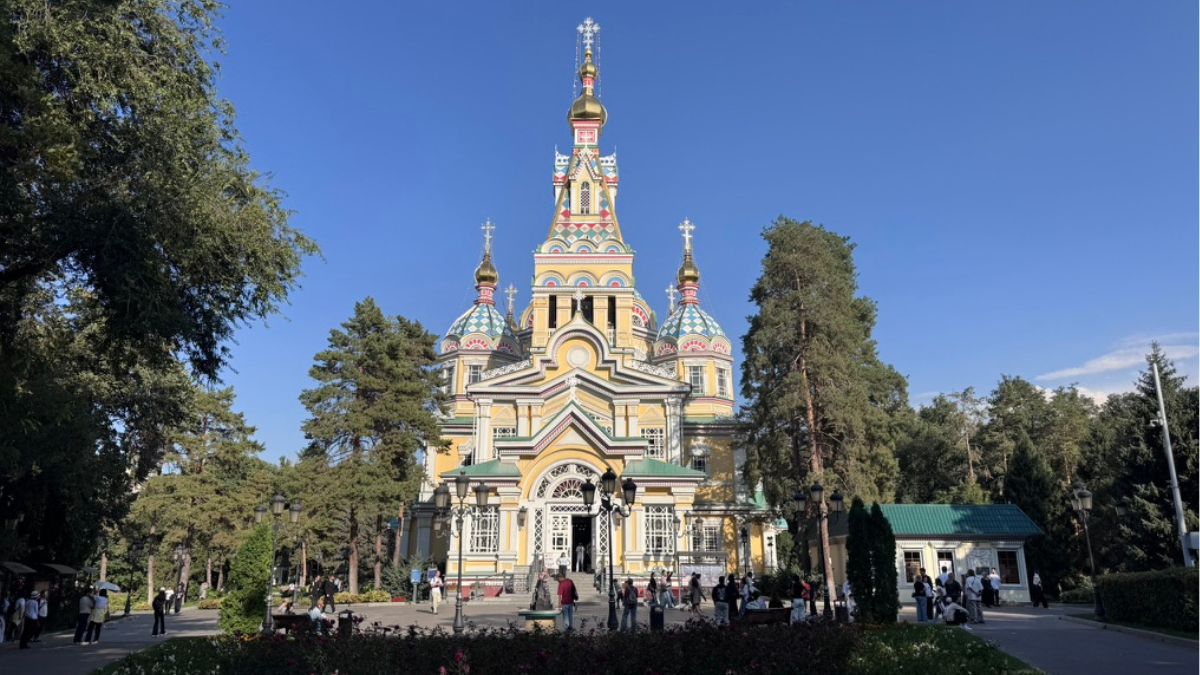
One of Almaty’s most striking buildings is Ascension Cathedral, also known as Zenkov Cathedral.
Set among the trees of Panfilov Park, its colourful domes and detailed wooden architecture make it an impressive sight. The interior is equally beautiful.
We were particularly fortunate with the timing of our visit because a wedding was taking place inside. Our guide told us she’d never encountered one during her tours before, so it was a special opportunity to see the cathedral being used for an important occasion.


Panfilov Park is also home to some significant war memorials, including the enormous sculptures surrounding the Eternal Flame.
We found this part of the tour especially interesting. The monuments are impressive in their own right, but hearing the stories behind them gave us a much deeper appreciation of their significance.
A taste of Kazakhstan at the Green Bazaar
Our walking tour also introduced us to some local food traditions.
We visited Rakhat, one of Kazakhstan’s best-known chocolate makers, before continuing to the Green Bazaar, where we encountered foods including kurt, a dried, salted dairy snack.
There was also the opportunity to sample fermented horse milk, although neither of us was particularly tempted!
The Green Bazaar is certainly worth knowing about, but we found it rather touristy and expensive. For us, the value of visiting was having Aigana explain the different foods and their place in Kazakh culture, rather than the shopping itself.
If you’re interested in local food, a guided visit can add considerably more to the experience than simply wandering around the stalls.
Exploring Almaty’s landmarks by bicycle
Almaty is a large city, but its extensive cycleways, leafy streets and public spaces make it surprisingly enjoyable to explore by bicycle.
We had our own bikes with us in It Zwibble, which gave us the freedom to venture beyond the historic centre and discover some of the city’s other landmarks.
Republic Square and the Independence Monument are worth including on a city sightseeing route. The square is an important public space, and its striking monument commemorates Kazakhstan’s independence.
Another landmark is Hotel Kazakhstan, a distinctive 25-storey building dating from 1977. With its elliptical shape and golden crown, it’s a wonderful example of Soviet modernist architecture and one of the city’s most recognisable buildings.
We also made a special trip to see something rather different: Birlik (Unity), a sculpture near the Sayran reservoir commemorating the rescue of a dog in 2016.
The original incident attracted international attention after a group of strangers formed a human chain to rescue the animal from a steep embankment. The sculpture recreates that moment of cooperation, with an outstretched hand that visitors can hold to become part of the chain.
It’s a lovely piece of public art, and the story behind it makes it particularly memorable.
Our cycling also gave us an opportunity to enjoy Almaty’s café culture, including a stop at Jumping Goat for coffee.
One of the things we appreciated most was how easy it was to combine sightseeing with simply enjoying the city. Almaty has plenty of impressive landmarks, but the tree-lined streets and public parks are attractions in themselves.


Almaty’s café culture is worth making time for
Something we hadn’t expected to enjoy quite so much was Almaty’s café scene.
There were plenty of inviting places to stop for coffee and cake, and the quality of what we tried was excellent. Jumping Goat was one of our stops while exploring the city by bicycle, and we enjoyed visiting other cafés during our stay.
We also noticed how smartly dressed people were. Almaty had a distinctly metropolitan feel, with fashionable young women meeting friends in cafés and people of all ages looking particularly well put together.
It was an interesting contrast with our experiences in Kyrgyzstan, where strangers had frequently struck up conversations with us. Almaty felt a little more reserved, although we still found it welcoming and had no major difficulties communicating in English.
Eating out wasn’t as inexpensive as we might have expected from travelling elsewhere in Central Asia. Prices were generally below what we’d pay in New Zealand, but not dramatically so.
As we were travelling in a self-contained campervan, we didn’t eat at restaurants every day. Nevertheless, the cafés, cakes and meals we did enjoy were consistently good.
If you’re visiting Almaty, we’d definitely recommend leaving time in your itinerary to enjoy its café culture rather than spending every day moving between attractions.
Exploring Almaty’s remarkable metro stations
Almaty’s metro is useful for getting around, but we discovered that it’s also an attraction in its own right.
During an earlier visit to Moscow, we’d enjoyed exploring the beautifully decorated underground stations. Almaty gave us an opportunity to do something similar.
The city’s metro was planned during the Soviet period but didn’t open until 2011, after Kazakhstan had become independent. Its stations feature a variety of artwork reflecting the country’s landscapes, history, literature and cultural identity.
We decided to explore the stations themselves, travelling along the line and stopping to look at the different designs.
Some of our favourites included:
- Almaly, with its beautiful apple-themed stained glass and mosaics.
- Abai, dedicated to the influential Kazakh poet and philosopher, and the deepest station we visited at 78 metres underground.
- Baikonur, with a futuristic design referencing Kazakhstan’s famous cosmodrome.
- Moscow, with red architectural details inspired by its namesake city.
- Zhibek Zholy, where a large Silk Road-themed artwork includes an intriguing collection of famous monuments from around the world.
What made the experience particularly interesting was seeing so many different aspects of Kazakhstan represented through the station designs.
It was also a great activity for a rainy day, something we appreciated when the warm autumn weather we’d been enjoying finally gave way to a cold spell.
You don’t need to visit every station to appreciate the artwork, but we’d certainly recommend taking a little time to look around rather than rushing straight onto the next train.


If you’re interested in exploring the stations yourself, the official Almaty Metro website has a guide to the stations and their individual designs. It’s worth having a look before you visit, particularly if you want to make the metro part of your sightseeing rather than simply using it for transport.
Escaping into the Tian Shan mountains
One of Almaty’s biggest advantages as a destination is how close it is to the mountains.
We loved being able to enjoy city life one day and head into the Tian Shan for a completely different experience the next.
Shymbulak: A mountain resort above the city
Shymbulak is a ski resort less than an hour from central Almaty, and even outside the winter season it’s worth considering for the scenery.
We’d originally hoped to go mountain biking, but that wasn’t available on the day we visited. Instead, we took the gondola up to the first station and walked back down.
The mountain views were lovely, although our route down wasn’t quite as straightforward as we’d expected. We initially found ourselves following a road before discovering a more pleasant route beside the river and a series of staircases.
The experience certainly gave us an appreciation for the setting.
We could imagine how fantastic Shymbulak would be during the ski season, and we’d love to return in winter to see the mountains covered in snow.
The wider mountain area also has an impressive skating facility at Medeu. We’d be interested in returning to try ice skating, although neither of us are strong skaters!

Before heading up the mountain, check the Shymbulak website for current gondola operations, tickets and seasonal activities. We’d hoped to do some mountain biking during our visit, so it’s worth confirming what’s available rather than assuming everything will be operating.
Oi Qaragai: Mountain fun for all ages
If you’re looking for a more activity-focused mountain outing, Oi Qaragai was one of our favourite experiences around Almaty.
The resort offers a range of recreational activities, with options that appeal to different ages.
We’d hoped to try both the mountain carts and alpine coaster, but only the coaster was operating when we visited.
That didn’t stop us having a great time. We bought two rides each, using the first to get familiar with the track and the second to pick up a little more speed. It was enormous fun, and we’d happily return to try more of the attractions.
Oi Qaragai would be particularly appealing for families, although we’d recommend checking which activities are operating before setting out. We were a little disappointed that some of the things we’d hoped to do weren’t available.
Oi Qaragai has plenty of activities beyond the alpine coaster, but availability can vary. We’d recommend checking the resort’s official website before visiting, especially if there’s a particular activity you’re keen to try.


Talgar Dam: A peaceful escape for overlanders
Our third mountain experience was quite different.
Near Talgar Dam, we found a lovely spot to park It Zwibble beside a small creek, with the sound of a larger river nearby. We ended up staying two nights, enjoying the peaceful surroundings while catching up on work and everyday vanlife.
For travellers with a self-contained campervan, this area is worth exploring as a possible place to spend some time away from the city.
It’s not the same sort of destination as Shymbulak or Oi Qaragai, but it offered exactly what we were looking for: somewhere quiet, scenic and close enough to Almaty that we didn’t feel isolated.
As always, anyone travelling independently would need to check access and parking arrangements for their own vehicle rather than assume a particular spot is available.
Finding places like this is one of the things we love about travelling in a self-contained campervan. We’ve also shared how we find overnight park-ups, from scenic spots like this to more practical places in cities.

A few practical things to know about visiting Almaty
After spending two weeks in the city, there are a few things we’d highlight for anyone planning a visit.
How long should you spend in Almaty?
For a city break, we’d suggest allowing five to seven days.
That would give you time to explore the historic centre, take a walking tour, enjoy the parks and cafés, discover some of the metro stations and spend a day or two in the mountains.
You could see the main city attractions in less time, but part of Almaty’s appeal is having the opportunity to enjoy the city itself rather than rushing between sights.
Getting around
Almaty is walkable in many areas, but it’s a large city.
We found a combination of walking, cycling, metro journeys and Yandex Go taxis worked particularly well.
The extensive cycleways were a pleasant surprise, although we’d recommend paying attention to local cycling arrangements and traffic conditions.
Yandex Go was inexpensive and reliable during our visit.
The metro was straightforward to use, while the buses required a little more planning because of their payment arrangements.
When to visit
We visited in late September and early October and thought it was a lovely time to be in Almaty.
Most days were pleasantly warm, with cooler mornings and evenings. We also experienced a couple of decidedly cold days, including some rain.
The autumn colours were beautiful, and the trees still had plenty of leaves, so the city retained the lush, green appearance we’d enjoyed since arriving.
We haven’t experienced Almaty in other seasons, but our early autumn visit certainly made a good impression.
Is Almaty expensive?
We found Almaty reasonably priced rather than exceptionally cheap.
Public transport and Yandex Go taxis were particularly affordable. Attractions generally felt fairly priced, while café and restaurant meals were somewhat cheaper than in New Zealand without being dramatically inexpensive.
For us, the quality of the food and cafés made those outings worthwhile.
Why Almaty deserves a place on your Kazakhstan itinerary
We came to Almaty because we needed to spend two weeks organising Russian transit visas for our onward journey.
That practical stop turned into one of those occasions when having extra time somewhere proved to be a real advantage.
We discovered a city with a wonderful amount of greenery, interesting history, beautiful public spaces and a café culture we thoroughly enjoyed. Getting around was easier than we’d expected, and the mountains offered opportunities to escape the city without travelling far.
What stayed with us most wasn’t a single landmark or attraction. It was the overall experience of being in Almaty: cycling through leafy streets, running in its parks, discovering the artwork beneath the city and heading into the mountains when we wanted a change of scenery.
For anyone planning a trip to Kazakhstan, we’d recommend giving Almaty a few days of your time.
And if you enjoy green cities, good coffee, history and mountain scenery, you might find yourself wanting to stay a little longer.
Leave a Reply