
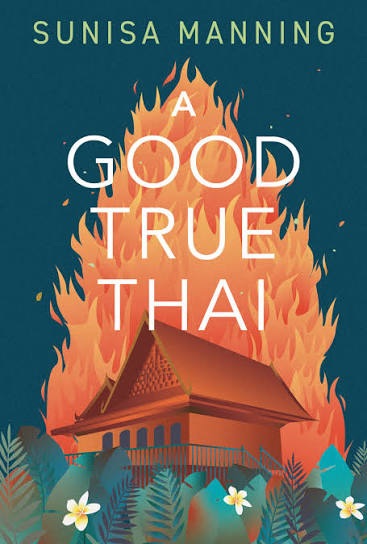
Before reading A Good True Thai, I had a fairly uncomplicated idea of Thailand’s modern history.
Compared with many of its neighbours, I had assumed Thailand had enjoyed relative political stability. It hadn’t experienced the colonial rule of countries around it, nor the devastating conflicts of Cambodia, Laos and Vietnam. Travelling through the country today, it is also very easy to encounter a Thailand that feels prosperous, welcoming and remarkably well set up for visitors.
Sunisa Manning’s novel challenged some of those assumptions.
Set against Thailand’s turbulent student democracy movement of the 1970s, A Good True Thai follows three university students, Det, Chang and Lek, whose personal relationships become entangled with the growing political unrest around them. Through their lives, Manning explores class, privilege, political idealism, gender and competing ideas about what it means to be a “good” Thai.
I read the novel while Darryl and I were driving the Mae Hong Son Loop in northern Thailand, often in absolutely torrential rain. While we negotiated winding mountain roads in It Zwibble, I was disappearing into a version of Thailand I hadn’t known existed.
That was probably the greatest surprise of the book for me.
I simply hadn’t appreciated how turbulent this period of Thai history had been. The student movement, military power, anti-communism and struggles over democracy opened up a side of modern Thailand that I knew very little about. Knowing far more about the upheavals experienced by Thailand’s neighbours had perhaps made me assume that Thailand itself had been comparatively stable.
One of the relationships I found most fascinating was the friendship between Det and Chang.
Men!
Their relationship is shaped by friendship, loyalty and affection, but also by all the things they don’t communicate particularly well. More importantly, there is a significant imbalance of power between them. Their different backgrounds and positions in Thai society affect the relationship even when neither man necessarily acknowledges it. Watching those tensions play out made their friendship one of the most interesting parts of the novel for me.
Initially, I was also drawn strongly to Lek.
She is ambitious and courageous, navigating both the political world around her and expectations about what a young woman should be. I wanted to see where Manning would take her.
Unfortunately, my feelings towards her changed as the novel progressed. Towards the end, I felt that a character who had seemed so interesting and independently driven began slipping into a much more familiar female role. Rather than becoming more compelling as events intensified, I found myself liking her less and less.
Perhaps appropriately, A Good True Thai left me thinking about the country itself in a less straightforward way too.
I loved travelling through Thailand. It is an extraordinary country, and we had wonderful experiences there. But our travels through Southeast Asia have also coincided with renewed conflict and tension along the Thailand-Cambodia border. Having spent time in Cambodia as well, I found it difficult to view those events as something distant or abstract.
I don’t think those two reactions have to cancel each other out.
You can love travelling through a country while also being troubled by aspects of its politics. You can admire its culture and people while questioning decisions made by governments and militaries. And you can discover that a place you thought you understood has a much more complicated history than you realised.
In that sense, A Good True Thai was exactly the kind of book I hoped to find when I started reading books connected to the countries we travel through. It didn’t simply give me a story set in Thailand. It exposed a gap in my understanding and made me curious about the history underneath the country I was seeing around me.
I’d recommend it particularly to readers interested in political and historical fiction, or to travellers who want to look beyond the Thailand most commonly presented to visitors. I didn’t love every character or every choice Manning made, but I came away from the novel knowing that my original picture of modern Thai history had been far too simple.
And that’s a pretty worthwhile thing for a book to do.
Leave a Reply