
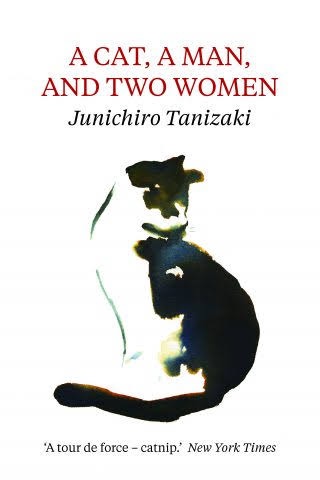
How Shozo managed to convince not one, but two women to marry him was one of the enduring mysteries of A Cat, a Man, and Two Women for me.
I found him spectacularly unlikeable.
Jun’ichirō Tanizaki’s short novel centres on Shozo, his former wife Shinako, his new wife Fukuko and Lily, the tortoiseshell cat who becomes the unlikely focus of the jealousy and manoeuvring between them. It’s a strange little domestic story about marriage, divorce, possession and attachment, with a cat sitting quite literally in the middle of it all.
I read the book while we were travelling around Hiroshima and Miyajima, and when I picked it up I hadn’t realised that it was originally published in the 1930s. In fact, it took me a while to notice.
What eventually gave it away were the descriptions of how the characters communicated with one another. Once I noticed those details, the period in which the novel was written suddenly became much clearer.
That realisation made me appreciate something else about the story: so much of it doesn’t feel particularly old.
The grief, anger and resentment at the end of a relationship are immediately recognisable. So are the arguments about possessions, the jealousy surrounding a former partner, the attempts to manipulate one another and the complicated question of who gets what when a shared life comes apart. Almost 90 years after Tanizaki wrote it, those emotions haven’t changed very much.
My feelings about the characters did change as I read, though.
Initially, I found Shinako surprisingly two-dimensional. Given that she is dealing with the breakdown of her marriage and Shozo’s remarriage, I expected to feel more connected to her. Instead, she seemed to exist largely in relation to Shozo and Fukuko.
Then she gets Lily.
For me, that’s where Shinako begins to develop into a much more interesting character. As her relationship with Lily evolves, we see more of her loneliness, motivations and emotional complexity. The cat who has been used almost like another possession in the fallout of a marriage becomes the means through which Shinako starts to feel like a fully realised person.
And then there is Lily herself.
Tanizaki absolutely nails the cat.
Lily is loved intensely by the humans around her while maintaining that wonderfully feline ability to remain somewhat indifferent to all of them. The people project meaning, loyalty and emotion onto her while Lily largely continues being Lily. Anyone who has ever loved a cat while being painfully aware that the intensity of the relationship may not be entirely mutual will recognise her immediately.
I certainly did.
We have a cat, Caesar, waiting for us back in New Zealand while Darryl and I travel the world. He’s being beautifully cared for by other people, and reading about Lily inevitably made me think about what will happen when we eventually return. Caesar was deeply attached to Darryl before we left. Will that attachment instantly resurface when they’re reunited? Will he remember exactly where he belongs?
Or will he look at us with complete feline indifference and wonder who these two people are?
After reading about Lily, I’m not making any assumptions.
For such a short novel, A Cat, a Man, and Two Women contains a surprising amount about relationships, jealousy, ownership and the ways humans try to possess both one another and the animals they love. Shozo never became any more likeable to me, and I remained slightly baffled that two women had wanted him in the first place. But perhaps that’s part of what makes the strange little triangle, or quadrangle if we’re giving Lily her rightful place, work so well.
I’d recommend this to readers interested in Japanese literature who want something beyond contemporary Japan, particularly anyone fascinated by the smaller domestic details of another time. It’s also a fascinating reminder that while the ways we communicate and the societies around us can change enormously, the emotional messiness of relationships is remarkably persistent.
And if you’re a cat person?
Lily alone might be worth the read.
Leave a Reply