
CHINA
I fell in love with China this year.
Darryl and I spent nearly six weeks exploring the country, first on an Intrepid tour and then driving It Zwibble all the way from the Laos border to Kyrgyzstan. It was one of the great surprises of our travels. The people were wonderful, the infrastructure extraordinary, the natural beauty breathtaking, and the sheer scale and diversity of the country endlessly fascinating.
I have been raving about China to anyone who will listen ever since.
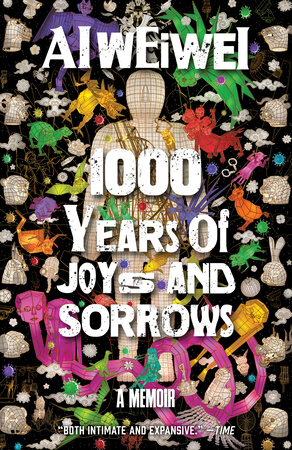
Which is perhaps why reading 1000 Years of Joys and Sorrows by Ai Weiwei was so confronting.
I knew of Ai Weiwei before picking up his autobiography. Like many people, I was familiar with his involvement in the design of Beijing’s 2008 Olympic Stadium, the famous Bird’s Nest, and his extraordinary Sunflower Seeds installation at London’s Tate Modern. I remember hearing about that exhibition at the time and wishing I could see it for myself.
What I hadn’t fully appreciated was the extent of the personal suffering that lay behind his work, or how deeply that suffering extended across generations of his family.
The autobiography tells two intertwined stories: Ai Weiwei’s own life as an artist, activist and outspoken critic of the Chinese government, and that of his father, Ai Qing, a celebrated poet who suffered persecution during Mao’s political campaigns.
Through their experiences, the book traces some of the most turbulent periods of modern Chinese history, from the revolutionary optimism of the early Communist era through the Anti-Rightist Campaign and Cultural Revolution, and into the increasingly prosperous but politically restrictive China of the 21st century.
What makes the story particularly powerful is the way these enormous political movements are experienced at a deeply personal level.
Ai Qing’s persecution, the family’s exile to remote parts of China, the humiliations they endured and the consequences for their everyday lives are difficult to reconcile with the ideals supposedly underpinning the political movements of the time. Decades later, Ai Weiwei’s own experiences of surveillance, detention and censorship demonstrate how the consequences of challenging authority continued into another generation.
And this was where I struggled.
Having spent so much time in China, I had developed a genuine affection for the country. I loved its energy, its extraordinary achievements and the people we met along the way. There was so much about modern China that impressed me, particularly the infrastructure and the pace at which the country has developed.
Yet here was a story of human suffering, spanning generations, arising in large part from people doing things I consider fundamental rights.
To question.
To challenge ideas.
To express an opinion.
To respond publicly to tragedy or injustice.
These are things I do almost without thinking. As a New Zealander, I have grown up in a society where questioning authority and expressing disagreement are ordinary parts of civic life. I have certainly never had to contemplate the possibility that doing so might result in imprisonment, exile or the persecution of my family.
For Ai Weiwei and his father, those consequences were not hypothetical.
One of the things that struck me most was the continuity between their experiences. Although their lives unfolded in very different periods of Chinese history, both found themselves confronting the consequences of speaking, writing or creating in ways that challenged those in power.
The book also made me think about the relationship between art and political expression.
I had previously known Ai Weiwei primarily through his extraordinary installations and his international reputation as a contemporary artist. Reading about the experiences that shaped him gave me a much deeper appreciation of why his work so often confronts authority, questions official narratives and responds to human suffering.
His art is not simply about making something visually striking. It is frequently inseparable from his determination to ask questions that others would prefer remain unanswered.
But what stayed with me most wasn’t any single artwork or political event. It was the uncomfortable contrast between the China I had experienced and the China described in these pages.
Of course, both can be true.
A country can be extraordinarily beautiful, its people welcoming, its infrastructure impressive and its cultural heritage remarkable, while also having a political system that places severe restrictions on individual freedoms.
Enjoying travelling through China doesn’t require me to ignore those restrictions. Equally, acknowledging the suffering described in Ai Weiwei’s autobiography doesn’t diminish the kindness, generosity and wonderful experiences we encountered during our travels.
Yet I found those realities difficult to hold together.
Perhaps because I had enjoyed China so much, the book challenged me more than it might have if I’d read it before visiting. It forced me to think about how much of a country we really understand as travellers, particularly when our experiences are shaped by the enormous privilege of being able to enter, explore and eventually leave.
We can admire what we see without necessarily understanding what life is like for those who live there, especially those whose experiences don’t fit comfortably within the national story presented to visitors.
I’d strongly recommend 1000 Years of Joys and Sorrows, particularly to readers interested in modern Chinese history, contemporary art, freedom of expression and the relationship between individuals and political power.
It is confronting, deeply personal and, at times, profoundly unsettling. But it also provides an important perspective on a country whose modern achievements are often discussed without equal attention to the human experiences behind its political history.
I finished this autobiography with mixed feelings. Not about the book, which I found compelling and thought-provoking. But about China.
I still love the country. I still recommend visiting it. I still find myself talking enthusiastically about our time there. But Ai Weiwei’s story has complicated that affection, and I think that’s something worth sitting with.
Sometimes the most valuable books aren’t the ones that change our minds entirely. They’re the ones that make it impossible to see something quite as simply as we did before.
Rating: ★★★★★
Leave a Reply