
Athens is one of my favourite cities to visit. My first trip was in 2006 and while things have changed in light of the political context during each of my subsequent visits over the last 9 years, Athens still remains a safe, enticing and welcoming European city.
September and October should be reserved to visit Athena’s city. July and August as simply too hot, too crowded and overpriced, whereas the autumn months still give visitors plenty of sunshine and stunning weather and less time waiting in queues.
What to do:
Acropolis:
This raised rocky fortification is THE must do while in Athens. It is open most of the year – closed on a few public holidays. Tickets cost €12 per adult, under 18s are free. The ticket also provides access to other archaeological sites around the city.

The Pathenon had to be the main draw card. The temple was built between 442 – 438 BCE to the virgin protectress of the city, Athena Parthenos, and is a marvel of ancient engineering; the entire building is curved, not a single right angle is used within the whole structure. Those classical architects knew a thing or two about mathematics and engineering and designed the building to appear optically perfect when viewed from below. The history of this temple reflects the occupation of Greece over the centuries. It has been a Roman temple, Christian church, ottoman mosque, and even a munitions store. Sadly, this last function left its scars on the building with the devastating destruction of the temple by cannonball in 1687. For visitors over the last thirty years or so, the Parthenon has been under reconstruction, sadly fixing the over zealous repairs of the last 150+ years. This building continues to be under public scrutiny with Greece demanding the return of the Elgin marbles to their rightful home. Thankfully Amal Clooney is on the case and there may be resolution for Greece shortly.
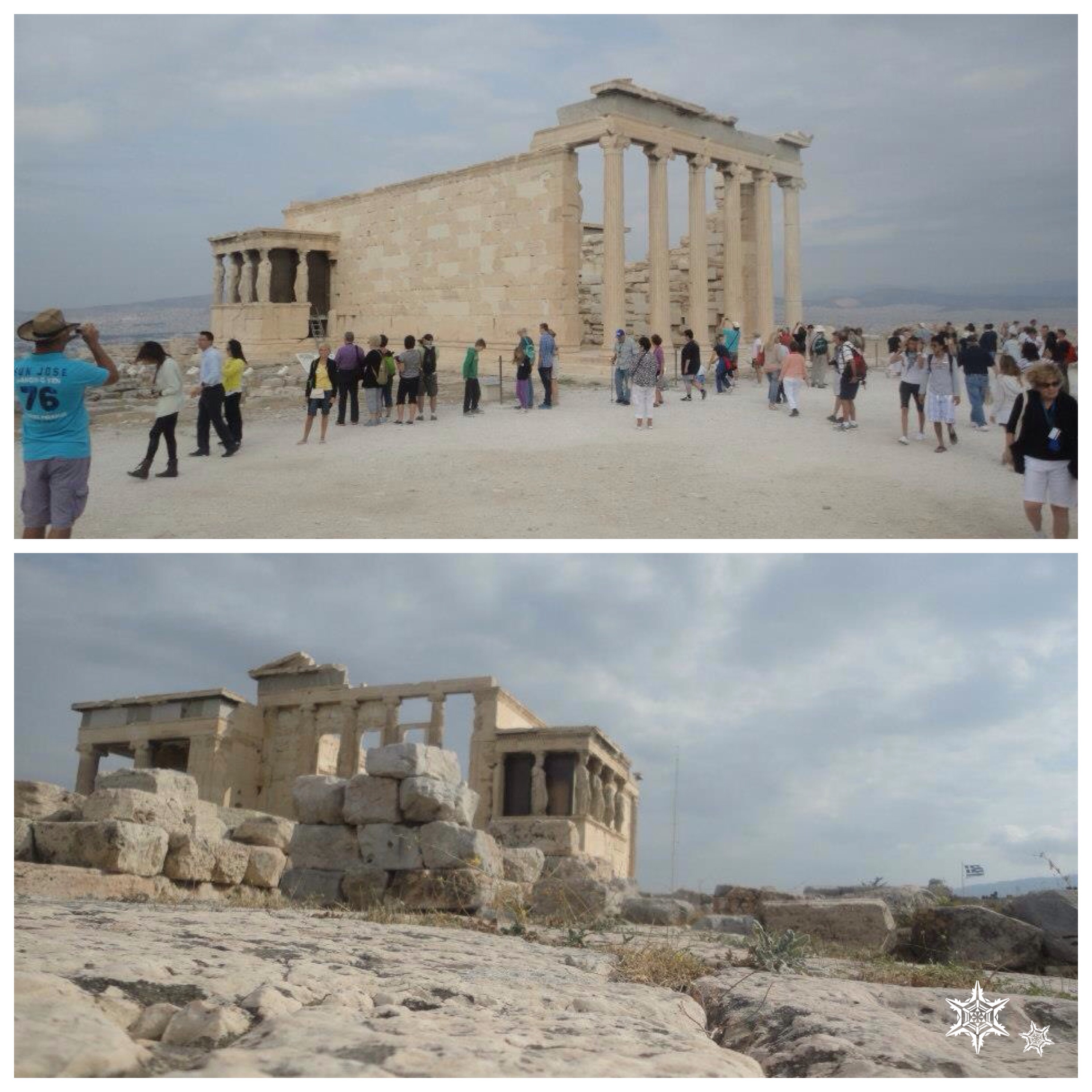
The Erechtheion is the other significant structure on the Acropolis, and my personal favourite. The temple was built to unify a range of religious sites and artefacts and this adds to its beauty. The slender ionic columns of the east facade represent the glory of ancient craftsmanship and visitors today can see two of the religious monuments that the Athenians wanted to protect. On the North side, there is a porch of columns on the lower level with a small opening up to the sky in the roof. Legend has it that when throw gods, Athena and Poseidon were vying for patronage of the city, each of them gifted something to the people. Poseidon threw his trident at the acropolis and a salt spring flourished where it hit, this is on the north side of this marvellous temple where the opening in the roof was to allow Poseidon the option of returning. On the west facade we see a large Olive tree, the only living thing up on this rocky outcrop, which was Athena’s gift to the city; she won them over with the olive tree, which was far more useful that a salt spring. Even today, the olive is everywhere in Athens and bringing home some olive oil as a souvenir or gift is quite a popular option. The porch of the maidens, the Karyatids, on the south side of this building is stunning, the sculpted women serve the role of columns. The story behind the purpose of these fair maidens is up for debate (more info here) and the sculpted Karyatids on the temple are replicas of the originals. Five of the originals are in the Acropolis museum and one still remains in the British Museum in London.
Acropolis museum
Opened to the public in 2009, the Acropolis Museum has to be one of the most stunning in the world. This cool, contemporary structure of steel and glass sits in stark contrast with the classical artefacts it was designed to house. On a sweltering summers day, the vast air conditioning is a welcome relief. Here you will find the treasures from the acropolis. While there are some earlier archaic pieces such as the pediment sculpture from the “old” Parthenon, most works date from the sack of Athens by the Persians in 480 BCE. The first floor is largely votive offerings, sculptures and artefacts from buildings atop the Acropolis, the star of the show has to be the top floor containing the sculptural works from the Parthenon. This is the only way you can get up close and personal with these art works. There is rooftop dining , with views overlooking the Acropolis or else there are heaps of other options in the streets nearby (see below). Tickets cost €5, under 18s are free.
 Up close and personal with the Karyatids from the Erechtheion in the Acropolis Museum.
National Archaeological Museum
This museum is a little further afield but I believe that it is worth the visit. To get here it is easiest to catch the metro to Omonia Square and then walk up 28 October Street until you arrive. This is not the super tourist part of Athens and I continue to be saddened by the empty stores and slightly derelict feeling that seems to be creeping in, this is where I see the impact of the Greek financial crisis. It is perfectly safe though, nothing to worry about! The museum is divided into three sections: prehistoric, sculptures, and vases and minor collections. I usually focus on the prehistoric section (which included the death mask of Agamemnon) and the sculptures. The vast collection is also worth a visit but I am drawn time and time again to the magnificent Artemision Bronze. Tickets are €7, with under 18s free. Alternatively, you could purchase a combined ticket for €12 and explore some of Athens many other wonderful museums.
 Artemision Bronze – probably either Zeus or Poseidon – at the National Archaeological Museum
Day trips from Athens:
It is really easy to travel to other wonderful parts of Greece for the day from Athens. SOME of my favourites (to be blogged about soon) are to head up to Delphi, over to Corinth, Mycanae and the ancient sanctuary of Epidauros, or to cruise the islands in the Saronic gulf. More to come later!
Where to eat:
Eating out in Athens is not hard to do! There are so many places which offer good, reasonably priced tourist-friendly options. Personally, my preference is fora good street gyro (kebab) like the locals eat or to venture over to the food market in Athinas St to purchase some fresh fruit (and check out the markets at the same time) a bit different from the supermarkets I’m used in New Zealand.
Around the Acropolis, the Plaka and Monastriki there is an abundance of restaurants and taverns. When in Greece, it is imperative to try the local cuisine. For me, the first night’s meal every time I come to this city is always a serving of Greek salad or tzatsiki followed by some moussaka. However there is more to Greek cuisine than this. I highly recommend spanakopita (spinach and cheese pie) as well as some of the local meat dishes. I’ve heard that the fish in Greece is very good but as I don’t eat it, I don’t feel that I can rightfully comment.
Like any tourist city, you pay much more to eat close to the tourist attractions. Yet compared with the rest of Europe, Greece is still quite reasonable. you can expect to get a decent meal in restaurant, excluding alcohol, for about €10 – 12 per person. Dining in the Plaka is like being on a Greek Island, there is foot traffic only, tables are laid out on the small winding streets and exceptionally friendly waiters try to entice you into their restaurant, which is always a very good price. On my last trip last I ventured over to where other locals were dining on the southern side of the Acropolis in Makrigianni St. We tried a few dinner places where over different nights but all in our group were quite taken with Yard bar. I’m not sure if that is because the decor was more modern or that the food was presented in a way that was more akin to our dining experiences back home (less of a taverna and more of a restaurant) but I would definitely go back here again.
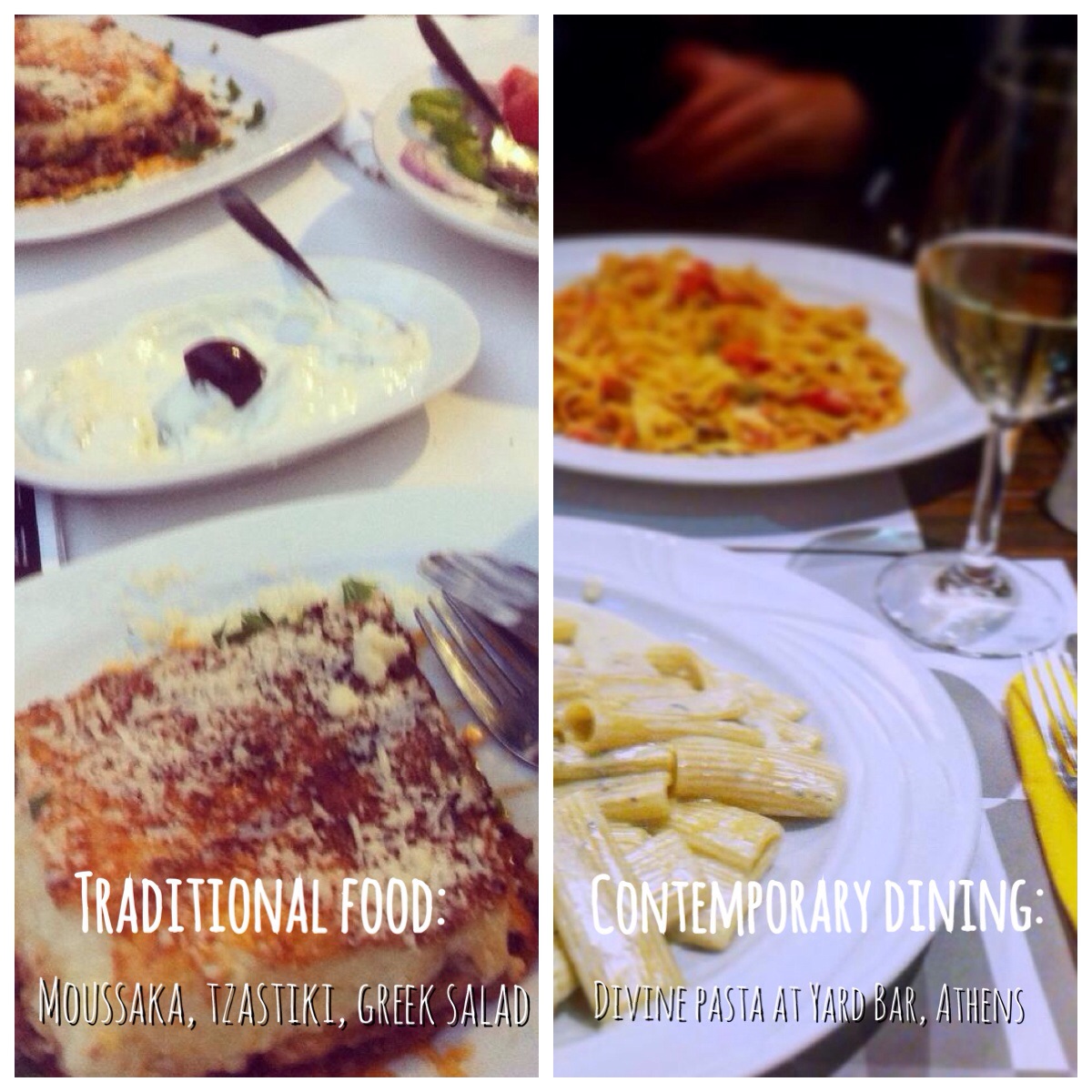 Food in Athens is simply wonderful!
Another wonderful place to eat is on Adrianou St in Monastriki. Ideally grab a table which overlooks the Agora and the Thission, a temple dedicated to Athena and Hephaestus (not to be confused with the Parthenon). My pick is at the pricier end of the market but Kuzina is a Michelin guide restaurant which serves neo-Greek cuisine. Compared to other Michelin restaurants around the world, this one won’t break the bank (even a teacher could afford it). Ideally nab one the tables outside, don your stylish sunglasses, grab a cocktail and while away the evening sunshine being seen in a hotspot. The food is pretty amazing too.
Where to stay:
Athens is riddled with accommodation options. I’ve stayed up near Omonia Square in a few non-descript hotels. But over time, I feel that I wanted to move closer to the old city. On my first trip, Omonia was a slightly dodgy area with enough colour to make the travel experience enjoyable, I wanted to feel that I was staying in a vast, busy city and I was not disappointed. The advent of the financial crisis in Greece means that this area has become less attractive for tourist with fewer amenities on hand.
In 2012, we stayed at the Student and Travellers Inn, right in the heart of the Plaka. The location was amazing; we were within walking distance from all attractions, bar the National Archaeological Museum. The rooms were decent sized with the option of booking an ensure room (which I did). There is a travel agent on site for any tour bookings and a fairly basic breakfast was included. For backpacker accommodation, this is some of the best I’ve come across.
In 2015, we stayed at the Acropolis View Hotel, which obviously is overlooking the Acropolis. I really liked the accommodation, the breakfast was a full continental – ham and feta cheese included- and the staff were really supportive of our group. The location was a bit too far away from restaurants and bars for my liking – about a 10 – 15 minute stroll to the Plaka. If you are looking for a quiet hotel where you won’t be disturbed, this is a good option. I wouldn’t rule out staying here again, it just depends on what you’re looking for.
What to buy:
Like any large cosmopolitan city, Athens has a range of shopping options. Ermou St is where I would start. If you are in the market for souvenirs or vintage finds then the Monastriki flea market is for you. The market side of this is from the Monastriki metro station and then heading towards the bustling markets. When I was here in 2015, we came across a great street market of handcrafted goods, jewellery and vintage stalls from the Thissio station up towards the Pnyx.
if markets are not really you thing and you are looking for some chain store shopping Athens can deliver there too. Start from Syntagma Square and head down Ermou, you’ll encountered almost all of the European chains stores and also be able to fit in a spot of people watching. When shopping gets too much stop in at a local bar and wile away the day as the locals do over a coffee or alcoholic drink,
Souvenirs from Athens are likely to include statuettes of their famous works of art, olive related products, spices, textiles, jewellery and clothing. The quality of these varies greatly, I used to buy lots of “stuff” and now I try to limit myself to something that I actually want in my house or one thing of good quality. On my last three trips to Athens my favourite buys were a small Art Deco onyx jewellery box which I hunted out in a second hand shop at the flea market and a large replica of one of my favourite Classical Greek vases. On the last trip, I purchased a board game (this seemed like a good idea but I may be regretting this one now). In the flea market and souvenir shops, haggle to get a better price, chances are that you’ll see exactly the same items in all shops so don’t feel compelled to buy something if the pressure is on.
Tips and tricks:
- Cash is king. Credit cards are widely accepted but you can get cash discounts in restaurant. Cash is also essential when ordering some of that delicious street food.
- Purchase your Acropolis entrance ticket at the Theatre of Dionysus entrance rather than the main entrance. Not only do you get a more scenic route, and to visit the theatre where Aeschylus, Sophocles and Euripides all debuted their plays, this side is far quieter, easier to access from the metro and you’ll avoid scores of cruise ship passengers at the ticket booth.
- Visit the Acropolis early in the morning to avoid crowds. The National Archaeological Museum is usually ok but it can get busy at the Acropolis Museum – early morning or towards closing is best here.
- Your Acropolis ticket also gets you admission to other archaeological sites. I highly recommend the Agora and Temple of Olympian Zeus. These are far less crowded than the Acropolis can be.
- keep track of when the free days are for entrance to the museums and sites. The Acropolis Museum has three free days (25 March, 18 May, 28 October), find out the Acropolis’ here.
- Feel free to haggle prices in Monastriki, even in shops. If the owners are not interested, they’ll let you know.
- Learn a few key phrases in Greek. Speaking English is not a problem but it is good manners when visiting other countries.
- Most signs are bilingual. The Greek alphabet is easy to master (with a little practice).
- Travel on the metro – it is one of the cleanest and most efficient in the world
- Be sensitive about the Greek financial crisis. Greek people are simply wonderful the day to day impact must be massive.
Travelling with kids:
- Teach your kids about Greek mythology before you go / as you’re away. It can be great fun to hunt out their favourite deities in the huge array of art works. Caleb’s favourite was Poseidon who proved to be harder to find in museums. The Acropolis Museum has a great programme for kids.
- if you are travelling with small children, I’d recommend a backpack rather than a buggy/stroller. You’ll want to visit the Acropolis (or the even rockier Areopagus beside it) and this is not ideal terrain for a stroller. Also, the winding, narrow streets of the Plaka would be easier the navigate with a child in a backpack.
- Take a break from the city and explore the national gardens off Syntagma Square
- Make sure to check out the changing of the guard at the tomb of the unknown warrior in Syntagma Square. The guards’ uniforms are antiquated and their movement sublime.
- Greek children stay up far later than I expected. It was not uncommon for us to see kids still playing in the summer months at the small playgrounds you find dotted all over the city at 11pm. These playgrounds are great, I love walking through them, after a great meal out somewhere, and seeing family life. This is what living in apartments means, more opportunities to bring the community together in public.

 The Peterson Odyssey